
Not very pleasant, right?
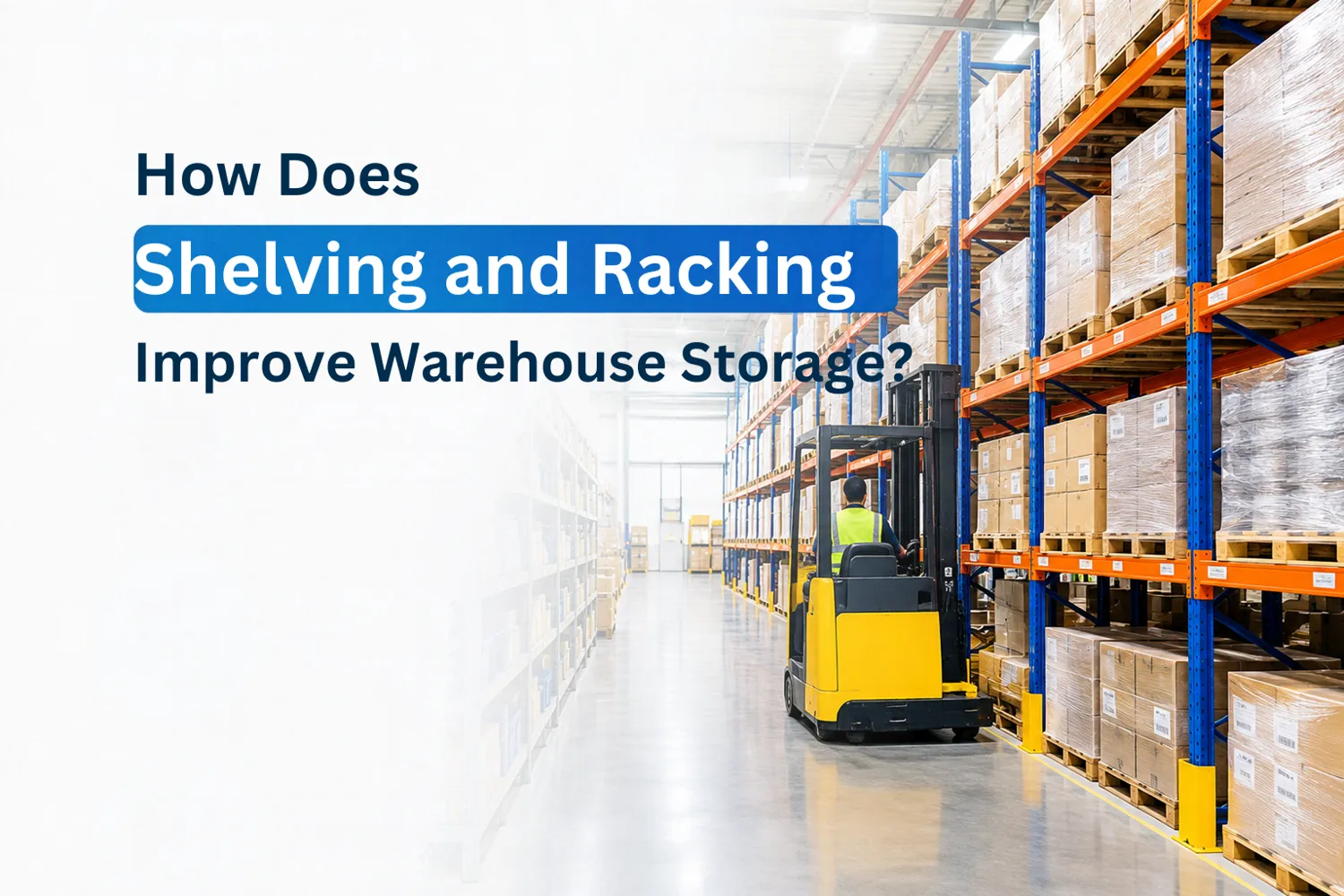
Now, think about the same warehouse but with shelves, labeled racks, enough aisle space and all the products arranged in the proper manner. It becomes very easy to access the products, counting has become easy and it is easier to work in such warehouses.
Here we come to the point where shelves and racks make differences.
There are many aspects of warehouse management, but with the management of storing products, it also helps in making proper use of space, organization of inventory, improvement of processes and safety in the warehouse. At times, racking helps in making use of vertical space apart from the floor space.
As per OSHA, the materials should be stored properly in such a way that they do not slide, fall or collapse and aisle space should also be clear.
Let us take a look on how shelving and racking can enhance the storage capability of warehouses.
What Are Shelving and Racking?
First of all, before we analyze the benefits, it is necessary to understand the meaning of these storage solutions.
Shelving is commonly applied for storage of small products, cartons, boxes, tools, spare parts, paperwork and other small items which can be manually picked.
Racking is normally utilized for storage of larger and heavier products, mainly palletized cargo. Most racks in warehouses consist of several layers, thus helping companies to store products vertically.
Imagine shelving as a big wardrobe consisting of multiple layers.
Racking can be seen as a steel structure in your warehouse where your palletized products and large items can be stored.
Ultimately, which storage solution will suit best for you will depend on type, size, weight and flow of your products.
And the key thing is simple – shelving and racking provide a place to each product.
1.Shelving and Racking Improve Space Utilization in the Warehouse
One of the main issues in warehouses is space constraint.
Companies may look at their warehouse floor and decide, “We need a larger building.”
There may be an easier way out.
Just look up.
Apart from floor space, a warehouse has another kind of very useful space – vertical space. Good racking helps to make use of vertical space by storing items in more than one level of the warehouse.
Thus, companies can store more products without having to immediately increase their building size.
In accordance with OSHA guidelines for warehouses, racking can help in increasing storage capacity by increasing the number of storage spaces or “slots”.
Instead of putting all 50 boxes on the floor, proper shelf arrangement would enable them to arrange these boxes in different levels of the shelves.
The floor becomes less cluttered, organizing products becomes easier, and workers get more space to move around.
2.It Is Useful in Organizing Products
The untidy warehouse environment soon becomes a guessing game.
“Where is that box?”
“Has it been relocated?”
“Isn’t it somewhere behind those pallets?”
This consumes time.
With the proper system of shelves and racks, the products can be segregated in different sections.
Some examples are as follows:
- Electronics will have their own section.
- Another section may be for spares.
- Fast moving products must be located near the picking zones.
- Heavy products must be located on the lower sections of racks.
- Slow moving products must be located in less accessible sections.
- Products of different sizes can be located in different sections.
Labeling, aisle, rack numbers, and product code can make life much easier.
The worker does not have to search all over the place for a particular item.
That’s the way it goes.
3. Shelving and Racking Can Save Time
Time is valuable in every business.
If a worker spends only five extra minutes finding an item, that might not sound like much.
But imagine 10 workers doing that several times a day.
Those minutes quickly become hours.
A well-organized warehouse reduces unnecessary searching and movement. Products have assigned locations, and workers can follow a predictable picking route
This can help improve:
- Picking speed
- Packing speed
- Order processing
- Stock checking
- Product movement
- Daily warehouse workflow
A warehouse does not need to move faster simply because workers are working harder.
Sometimes, it becomes faster because the storage system is designed better.
4.It Makes Sure That The Inventory Is Easy to Manage
Suppose you have a thousand products, but you don’t have any means to stock them. It would be hard for you to keep tabs on everything. Shelving and racking helps in making a sensible arrangement of the inventory. Every product can have its own place. This would help warehouse workers figure out:
- What they have in stocks
- Where the products are stocked
- How much of each product they have
- What products have few stocks
- What products sell quickly
- What products take a while to sell
Prearranged spaces would help in counting stocks easily.
If every product has a pre-assigned place, then it won’t be necessary for you to randomly search in piles of crates.
This becomes even more useful for companies dealing with a variety of products daily.
5.It Can Enhance Warehouse Safety
A well-organized warehouse is supposed to be efficient but it should also be safe.
Uncontrolled placement of products can result in certain safety risks.
Products may fall off. Walkways may be blocked by various materials. Heavy items may be improperly placed. Racks may be in poor condition and be hazardous.
Well-designed shelving and racking systems may contribute to the creation of a more controlled warehouse interior.
According to OSHA, materials have to be arranged, stacked, racked, blocked, interlocked or other way of securing them to prevent sliding, falling, or collapse. Also, OSHA states that clear aisles and passages have to be provided as per the applicable storage requirements.
Warehouse safety guidelines also suggest proper inspection of shelves and racks, no overloading, proper distribution of weight and clear aisles.
However, the purchase of a rack does not mean that a warehouse will be safe.
The rack should be appropriate for the load, properly installed and loaded.
6. It Helps Protect Products
Products sitting on a warehouse floor can be exposed to many problems.
They can be:
- Hit by equipment
- Knocked over
- Covered with dirt
- Damaged by poor stacking
- Difficult to access
- Mixed up with other products
Shelving and racking give products dedicated storage positions.
This can help reduce unnecessary handling and make goods easier to protect.
For example, a fragile product can have a designated shelf rather than being placed
underneath a heavy box.
Similarly, heavier items can be stored in suitable rack positions rather than being
placed randomly on top of lighter products.
Good storage is therefore not only about how much you can store.
It is also about how well you can store it.
7.It Can Enhance Employee Efficiency
Take, for example, an employee looking for a small box in an unorganized warehouse.
The employee could be walking around the place, moving some other boxes, consulting another employee, and then finding the product after spending some time searching.
In contrast, think of the employee who has the following:
Aisle 4 → Rack B → Level 3 → Product Code 245.
The contrast is evident.
An organized warehouse provides employees with an easy path to follow.
Additionally, an organized warehouse can minimize unnecessary steps, lifting, bending, and reaching if the warehouse is organized in a manner that suits the products and tasks involved.
According to OSHA, work done in a warehouse may have ergonomic hazards like overexertion and awkward access to stored products.
This is because designing a warehouse should take into account not only its storage capacity but also how people use it.
8. Shelving and Racking Can Make Future Growth Easier
Businesses change.
A small company today may have twice as much inventory next year.
If the warehouse has no flexible storage plan, growth can quickly create a problem.
A well-planned shelving and racking system can provide room for future changes.
- Add storage levels
- Change shelf positions
- Reorganize product locations
- Create additional storage sections
- Adapt the layout as inventory changes
This flexibility is valuable because warehouse storage should support the business—not hold it back.
9.Various Items Require Various Storage Methods
There is no one universal storage system that suits all warehouses equally well.
The requirements for a warehouse storing tiny spare parts are different from those of a warehouse storing huge pallets.
Examples include the following:
Tiny items:
Shelving, bin shelving, and small-parts storage might work well.
Large items:
Pallet racking may be an option worth considering.
Items that are long:
Special storage may be required for pipes, timber, or long metal items
10.It Aids in Creating a Clean and Professional Environment of a Warehouse
A clean environment in a warehouse makes the work easy.
When shelves and racks are clearly placed, there will be fewer chances of spreading out the products on the pathways.
Well-organized warehouses could also help in spotting issues quickly.
For instance, the missing box or misplaced item would become instantly obvious.
Clear aisles will also make the movement easy for both people and machines.
OSHA has identified clear aisles and pathways as one of the requirements for the safe storage of material.
Selection of the Proper Storage Racks and Shelves
There are some points you have to think about prior to purchasing a storage system.
- What do you want to store?
Is it light, bulky, heavy, fragile, long or palletized material?
- What load capacity could the products reach?
Each storage system has specific capacity requirements. Do not assume the capacity of the shelves and racks could meet all your needs automatically.
- How frequently would you need to access the products?
Frequent items should be more available than those you will not require for weeks.
- How tall is your warehouse?
The height could provide additional storage space, but only if it was planned for.
- What movements should be provided?
Adequate aisles for personnel, forklifts, pallet trucks, loading area, and even emergency passage are required.
- Would you like to increase the product quantity?
Your storage system has to be scalable to your future needs.
- How will you be maintaining it?
Shelving and racks need maintenance. The damaged components cannot be just ignored.
Frequently Asked Questions on Shelving and Racking
1.What is the main purpose of shelving and racking?
Main purposes include organizing, accessing, and appropriateness of the storage of the products as well as optimality of warehouse space utilization.
2.What is the difference between shelving and racking?
Shelving is mainly used to store lighter or smaller items, and it is usually picked up manually. Racking is mainly used to store large and heavy items and it may have more than one level in storage vertically.
3.Does racking increase storage capacity of warehouses?
It may increase storage capacity because it enables multi-level storage in the warehouse due to vertical utilization of the warehouse space.
4.Is shelving and racking safe?
If the correct equipment is correctly installed and loaded and correctly maintained, it is safe. However, strict adherence to the load limits, the inspection process, and access to the shelving and racking systems should be observed, among others.
5.How can shelving and racking increase productivity?
Because it enables designated locations of the products and saves time to pick, pack, and move the products.
6.How do I choose the correct warehouse racking system?
Product weight, product size, pallet size, storage height, picking rate, floor space,
Conclusion
The efficiency of the warehouse will never be achieved because of the spaciousness of the warehouse.
The efficiency will only be achieved if the warehouse uses its space effectively.
This is what the importance of shelves and racks is about.
With shelves and racks, the disordered warehouse becomes a storage place, which makes it easier for us to find products, move around, inventory products, and store them effectively.
A warehouse which is spacious is not always efficient.
The efficient warehouse is that in which everything has its own place and every aisle serves its purpose.