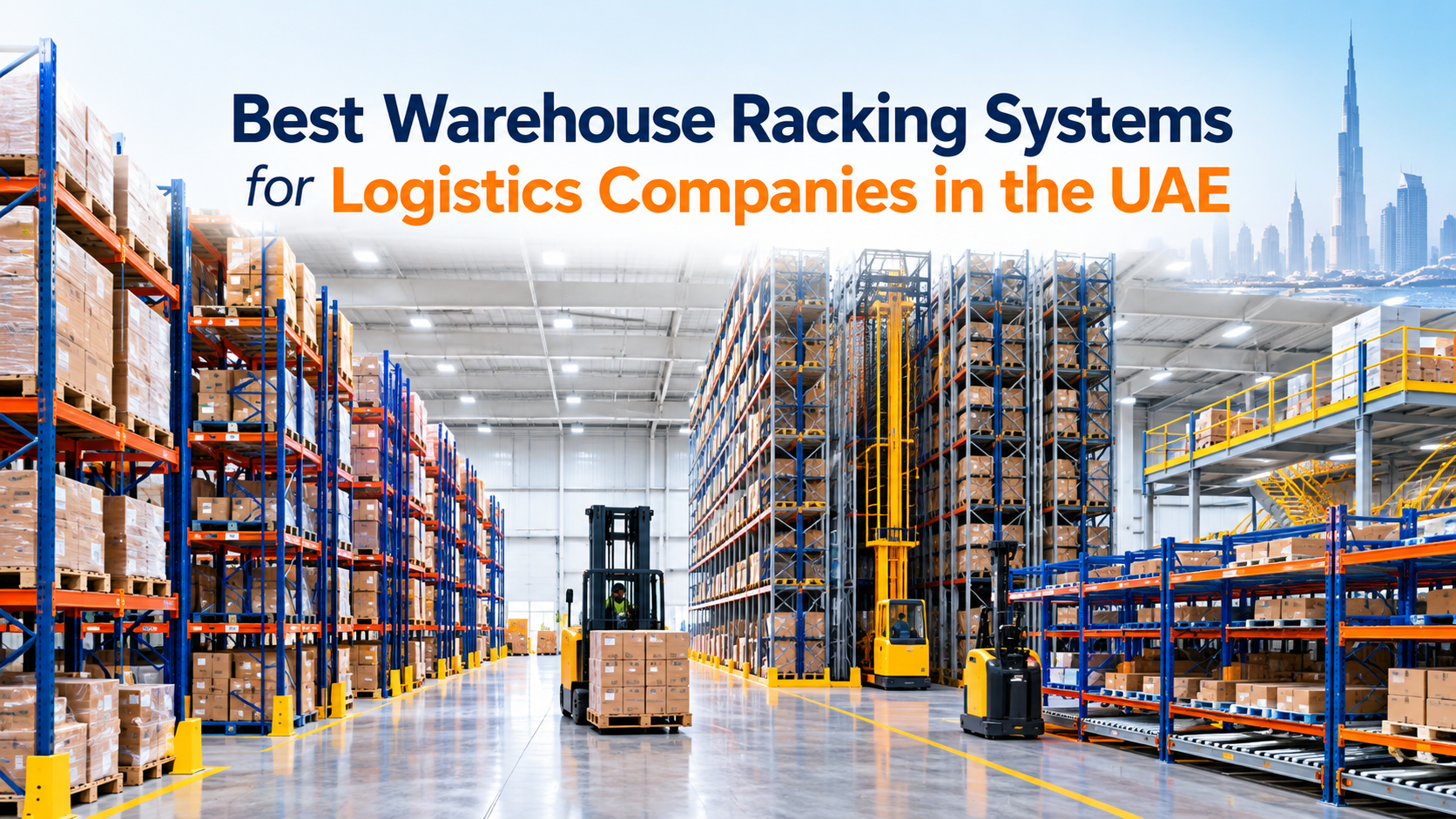
Selectively, most logistics warehouses would find selective pallet racking to be practical since it is more practical for warehouses where there is direct access to individual pallets and different SKUs. High-density storage will be served by drive-in and push-back racks while VNA racking would suit logistics where maximizing vertical space is needed in small floor spaces. Stock rotation may benefit from pallet flow racks while mobile racking is good when storage capacity is maximized using limited space.
It’s not just about putting more pallets in your warehouse when choosing warehouse racking solutions UAE. The racking system should work harmoniously with the warehouse design, forklifts, material handling process, safety concerns and inventory movements in the warehouse.
Logistics companies have an easy target – to store more efficiently, access products quickly, optimize space available, and maintain order
What Are Warehouse Racking Solutions?
Warehouse racking solutions UAE are storage systems designed to organize goods and make better use of available warehouse space.
Unlike simply placing products on the floor, racking allows businesses to use both floor space and vertical space. Depending on the system, pallets, cartons, boxes, equipment, and other goods can be stored at different heights.
For logistics companies, warehouse racking can help:
- Increase storage capacity
- Improve inventory organization
- Make products easier to access
- Reduce unnecessary movement
- Improve warehouse workflow
- Support safer material handling
- Make better use of vertical space
We provides different racking and shelving systems for warehouses and industrial operations across the UAE, including heavy-duty racking, drive-in racking, VNA racking, pallet flow racking, mobile racking, and push-back racking.
One pallet setup does not fit every logistics site.
What works best depends on the type of goods, the way the warehouse is built, how much space you use per item, how pallets travel around the floor, and how quickly each order must be loaded. Selective pallet racking can be a good option when staff take pallets straight off the rack and need clear paths. Other choices, like drive-in, push-back, VNA, pallet flow, and mobile racking, are picked more often when space is short and you want more storage per square meter.
Main options include the ones below.
1.Selective pallet racking
Selective pallet racking shows up in a lot of warehouses.
A worker can pull one pallet at a time. There is no need to move other pallets first. This can matter when a site ships many different product types.
Example: one warehouse serves several customers. One customer may request five pallets in a day. Another may need two. When pallets stay reachable, picking and routine checks tend to go with fewer slowdowns.
Why teams go with this option
- Pallets are reached one at a time
- It supports mixed goods and many SKU types
- Bays can be added later, or the layout can be changed
- Forklifts can move in a direct way
- Inventory updates can be handled without major shifts
If you carry a wide mix of products and you want calm, steady access to pallets, selective pallet racking is a solid place to start.
2.Drive-In Racking
Drive-in racking is made for storing a lot in a small footprint.
With this system, a forklift can drive into the rack and put pallets farther back in the lane. Because of that, fewer aisles are needed. More pallets can fit in the same storage area.
Drive-in racking a high-density option for low-mix storage. It is used when forklifts need to go into deep lanes to place pallets.
Drive-in racking can be a good fit for:
- Big volumes of the same type of item
- Bulk storage needs
- Warehouses where floor space is tight
- Goods that do not need pallet-by-pallet access very often
Still, it may not be the right move when a warehouse has a large mix of SKUs.
3.VNA racking
VNA racking means very narrow aisle racking. It makes the aisle thinner, so you get more room for goods.
This matters when a warehouse is tall and the floor area costs a lot. In that setup, height is the big factor.
With VNA systems, you can hold more pallets without widening the site footprint. VNA racking is a good option for crowded locations.
VNA racking is a good fit if these points are met:
- The building has enough ceiling height
- Floor space is tight
- You need a high storage density
- You have the right lift or handling gear
- Pallets still need direct access
The key idea is not hard. Plan VNA for the real warehouse movement and workflow. Do not add it only because it looks like it stores more.
4. Push-Back Racking
Push-back racking is another high-density storage option.
It allows multiple pallets to be stored in the same lane. When a new pallet is loaded, it pushes the existing pallet deeper into the lane.
This can help logistics companies increase storage density while maintaining relatively good access compared with some other high-density systems.
Push-back racking is generally associated with LIFO storage, so it should be selected based on inventory movement requirements.
We offer push-back racking as part of its warehouse storage solutions.
5.Pallet flow racking
Pallet flow racking uses rollers. Pallets roll ahead with help from gravity.
It fits well when you need good stock rotation.
For instance, a warehouse that follows FIFO rules may see benefits. FIFO means older goods should go out first.
Pallet flow racking a high density setup. It also says it helps pallets move quickly on gravity roller lanes.
So it can be a good option for teams focused on keeping inventory moving and rotating.
6.Mobile racking uses rack frames that sit on wheels and rails.
With this setup, you do not keep one fixed passage between every row.
Instead, you open an aisle only when you need to reach a specific rack.
Storage can rise quite a lot, but the layout and daily use take more care than standard pallet racking.
You may choose mobile racking when floor space is costly and storage volume matters most.
Why warehouses need more than racks
Racks help with storage, but they do not run the site by themselves.
People still have to do the work every day. Staff carry cartons, handle pallets, put items in the right spots, and ship goods on time. So, in the UAE, warehouse equipment is not a quick extra.
The right tools cover daily needs, like:
- Forklifts
- Stackers
- Pallet jacks
- Trolleys
- Cargo scissor lifts
- Lifting tools
- Safety gear
- Other ways to move and control materials
The range covers stackers and forklifts, trolleys, cargo scissor lifts, barrel lifters or tilters. It also covers other choices made for safe and smooth movement, and steady output.
The takeaway is simple. Choose racks along with the right handling tools.
If you set up narrow aisles and do not think about how a forklift will work there, you will likely hit delays. Things like rack layout, aisle width, pallet size, load weight, and how materials are lifted all have to fit together.
Warehouse racking in the UAE can shape costs.
Most warehouses already use a lot of floor space. On top of that, rent and electricity charges go up in the same area. If the layout gets rushed, a firm may need extra space earlier than it planned.
A good racking system can help a company use the space it already pays for. It can also speed up picking and moving pallets in and out.
This matters a lot for logistics and distribution teams. Their plans depend on trucks arriving on time and leaving fast.
Better racking is not only about squeezing in more pallet spots. If you pack shelves too closely, the day to day flow can slow down. Staff then spend more time walking and re-positioning items.
A practical racking plan should match a few core needs, like:
- Storage zones that fit what is actually kept there
- Clear access so workers can reach items without extra trips
- Safe setup during busy times
- Walkways that remain open for daily movement
- Faster handling at each step
Because of that, warehouse planning should look at the full flow of work. It should not focus only on the rack price at the start.
Racking System and Handling Equipment Should Work Together in Unison
Let us assume that a warehouse is a school.
Then, the racking system is the book shelf; products are the books whereas the forklifts are the people transporting books from one place to another.
If the book shelves are set up too close together, then it would make the transportation of people difficult. Similarly, if the book shelves are kept too low, the space available will not be utilized properly. Lack of labeling and organization also makes finding a specific book very hard.
Similarly, warehouses function in the same manner.
The best Warehouse racking systems UAE ensure that integration of storage systems and proper Warehouse operational equipment UAE results in an efficient flow of work.
For logistic companies, it would mean an efficient picking process, space management, improved organization, and safety during their regular course of business.
Conclusion
There is no “one size fits all” perfect warehouse racking system UAE .
Selective pallet racks may be highly beneficial when it comes to flexibility and access. Drive-in racks can offer efficient storage of the proper type of products. Racks with VNA can offer efficient usage of the vertical space and narrow aisles. Push-back and pallet flow racks can meet some specific needs of inventory movement. Mobile racking can allow the company to utilize the storage capacity.
The most appropriate choice will depend on the warehouse, products, equipment and process.
Know what you store, how often it moves, the available space and equipment. Choose the racking system which suits this combination of factors.
A properly organized warehouse can do more than just store the products. It can improve the performance of your whole logistics operations.