
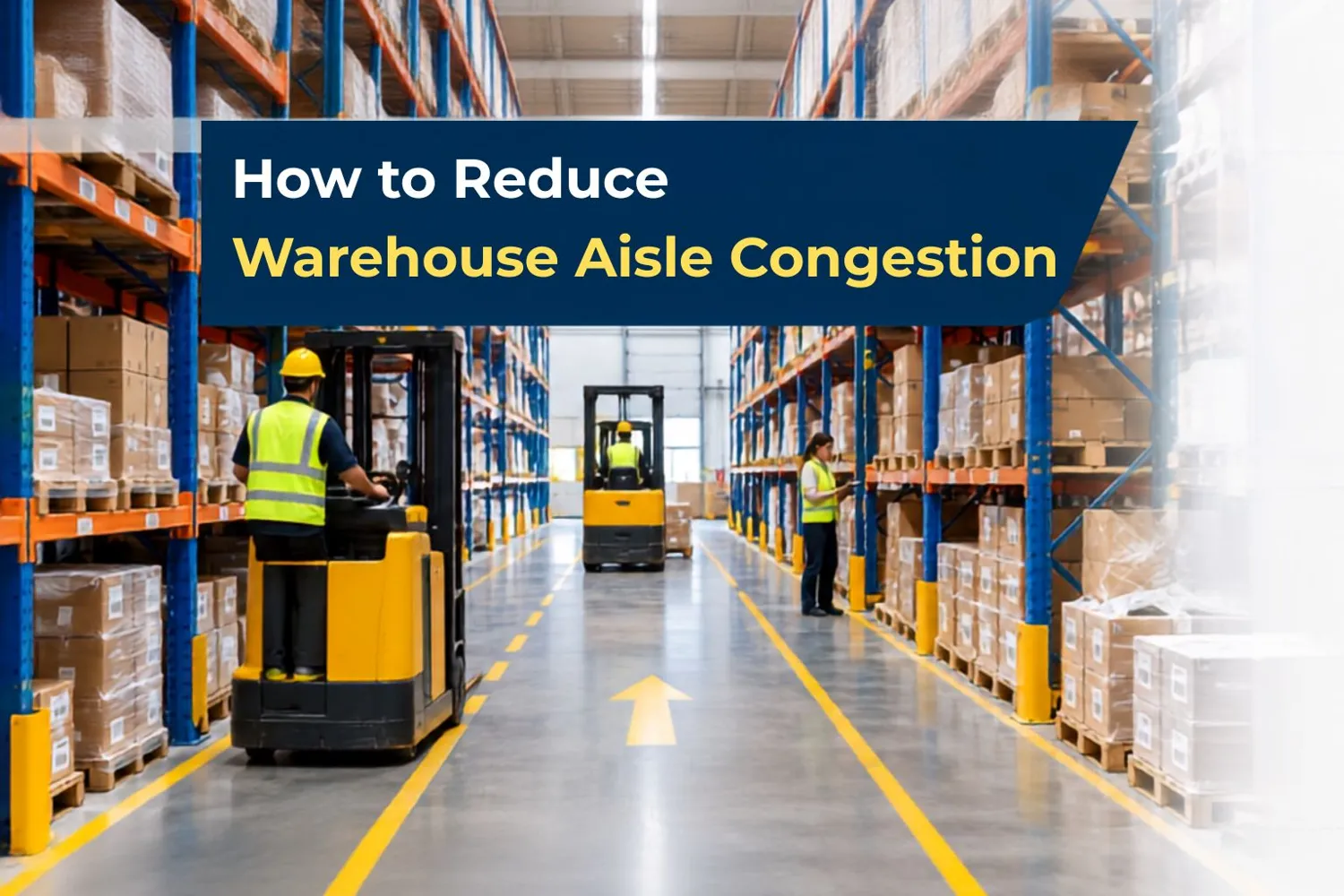
Of course, once your aisles become congested – i.e., when you notice minor slowdowns turning into larger-scale slowdowns because aisles are becoming clogged up by blocked off pick faces, lengthy lines of forklift traffic or pedestrians running the gamut through the maze-like pathways – most warehouse managers initially think about addressing labor or traffic problems. However, in many cases such congestion stems from various inefficiencies related to other key components of your warehouse environment including, but certainly not limited to, storage layout, SKU inventory levels, availability and use of materials-handling tools, and much more. As such, it’s critical that you identify exactly where those areas of congestion exist and why before jumping straight toward possible solutions for increasing speeds among workers (and perhaps even foklift operations).
Instead of worrying about getting faster, ask yourself what could be happening behind the scenes that’s triggering unnecessary congestion? What could a warehouse manager do to address those root causes instead of just looking toward making everything quicker?
What Causes Warehouse Aisle Congestion?
The root cause of warehouse aisle congestion lies in an imbalance between demand and supply.
This usually happens due to various competing factors vying for one another’s spot within your storage aisles simultaneously.
Common causes include:
- High concentrations of fast-moving SKUs
- Forklifts and pedestrians sharing the same routes
- Replenishment during peak picking periods
- Pallets or materials temporarily stored in travel lanes
- Insufficient staging and buffer space
- Incorrect material-handling equipment for the aisle configuration
- Excessive SKU travel and backtracking
- Poor inventory slotting
- Increasing order volume without adapting the storage layout
Not all aisles being busy are problems — you’d expect them to be busier anyway because of their nature.
The real issue comes into play if the amount of traffic consistently impairs your operations, such as picking, replenishment, putaway, or material movements.
How to Identify Where Congestion Occurs
Identify where exactly you’re having these issues – i.e., which location/activity within the warehouse is causing the bottleneck. It’s important to understand what goes on inside your warehouses when things are at their busiest, not just during times of relative calm.
Look for:
For example:
- Forklifts are waiting for access.
- Pickers have stopped their activities to make room for equipment to go through.
- Pallets restrict or block travel paths.
- There’s queues at intersections of aisles.
- There’s repeated instances of forklift needing to turn/reverse.
- Pickers backtracking frequently.
- Replenishment blocks active pick locations.
- Congestion near receiving/dispatch areas.
- Staging that has taken up space within circulation space.
Many times, cross-aisles, high volume pick faces, transitions from receiving to storage and dispatch areas will tend to be congestion hotspots as they’re where several different processes converge on each other. The key here is determining if this is due to layout, slotting, staging, replenishment timing, equipment or traffic behaviour before you invest money in solving the problem.
1.Optimize the Warehouse Layout
Layout of warehouse is also one of the most important factors that causes warehouse aisle congestion since this determines the way of movement of peoples, forklift and inventory within facilities.
Where the building permits changes, consider:
- Create wider main traffic aisles as dictated by equipment and operating conditions.
- Add cross aisles at strategic points within the facility.
- Segregate major through-traffic routes from areas actively engaged in picking operations.
- Reduce unnecessary travel between storage and dispatch.
- Establish dedicated staging/waiting areas. Segregate pedestrian and forklift movement when possible.
- Position high-traffic activities in locations that will help avoid conflicting movements.
Remember that designing the warehouse layout with an eye toward maximizing the number of pallet positions may appear to be logical — after all, why not pack every inch? But you’ll need to make trade-offs on how much density can be achieved without impacting the efficiency of other elements such as accessibility, travel distance, equipment requirements and throughput.
Consider this example: A highly dense racking configuration maximizes storage space, but if aisle dimensions aren’t properly sized relative to your handling equipment, you could end up slowing down travel speed or making some equipment maneuvers considerably harder than they have to be.
2.Improve SKU Slotting
SKU Slotting involves assigning your inventory to different locations within the warehouse, taking into account several factors such as their demand levels, sizes, weights, how often you need to restock them, etc.
Not having good SKU slotting processes will cause congestion inside your warehouses, regardless of whether they have a good layout.
For example, you don’t want all your fast-moving products to end up in one location, leading to massive traffic buildup there. But this doesn’t necessarily mean that you should position each other’s fast-moving SKU close to one another.
As you can see, there are many different slotting strategies that work well depending on your particular operation.
Consider:
- High volume product SKU’s Product Dimensions & cube
- Product Weight
- Replenishment Frequency
- Picking Method
- Equipment Requirements
- Order Profiles
- Proximity To Dispatch Frequency Of Simultaneous Demand
If there are multiple high volume SKUs which draw all your pickers into a certain section of the store then spreading these products out along each pick path might help avoid congestion within this area. Similarly if some products keep showing up on the same order list then you should position them next to each other.
Of course the goal isn’t just to throw all our fast movers into the most convenient location. Rather, we want to optimize for minimizing the total amount of travel and interference, while still optimizing for efficiently accessing our inventory.
3.Separate Replenishment From Peak Picking
As forklifts enter into an area where active order picking has been taking place during busy times, there may be congestion around the aisles. Schedule replenishment to happen outside of the busiest times of picking if possible.
Possible approaches include:
- Completing replenishment before peak picking begins
- Establishing scheduled replenishment windows
- Using wave-based replenishment
- Increasing forward-pick capacity for frequently picked products
- Moving reserve inventory through less congested routes
- Creating dedicated reserve and forward-picking zones
Scheduling isn’t going to solve your issues if you have consistently undersized pick faces, or if there’s inaccuracies in inventory records for example.
You might also want to look at whether there are some slots that require urgent replenishment more than others, which could point to an issue with the slotting or inventory planning decision.
4. Match Material-Handling Equipment to Aisle Design
The equipment operating in a warehouse must be compatible with its aisle dimensions and storage system.
Forklift and material-handling requirements can affect:
- Required aisle width
- Turning movements
- Travel speed
- Visibility
- Load stability
- Lift height
- Operator maneuverability
- Interaction with pedestrians
For example, equipment designed for wider aisles may not be appropriate for a narrow-aisle application. Conversely, specialized narrow-aisle equipment can support higher-density storage when the warehouse layout, racking, operating procedures, and equipment are designed as one system.
Before changing equipment, evaluate the complete operating environment rather than looking at the truck in isolation.
The right equipment should support the warehouse’s storage strategy and traffic flow rather than create additional movement conflicts.
5.Control Temporary Pallet Staging
One of the easiest ways to utilize all possible space inside aisles is the temporary pallet placement method.
Here’s what happens when you leave a pallet on an aisle for a couple of minutes:
- Restrict forklift access
- Reduce pedestrian clearance
- Block visibility
- Force detours
- Create additional turning movements
- Increase the likelihood of traffic conflicts
Because of this, we recommend defining clear boundaries to your staging areas with sufficient capacity to meet your projected operating volume.
In other words, instead of saying ‘Where can I put my receipt? Dispatch? Returns?’ etc., simply allocate an area specifically for those purposes and ensure each has their own dedicated location (as opposed to using what’s on hand). If you see pallets spilling over into your travel lanes, there’s a good chance that you either lack adequate staging capacity, or you’re failing to utilize the space within your warehouse optimally.
Particularly at core stores, storage optimisation techniques such as re-location of slower-moving stock (support material, etc.) out of non-core stores onto better-suited sites helps free up floor area which would otherwise be consumed during movements and operations.
6. Establish Simple Warehouse Traffic Rules
Traffic management can reduce congestion when the rules are practical and easy to follow.
Depending on the warehouse environment, useful controls may include:
- One-way traffic routes
- Clearly marked pedestrian walkways
- Forklift exclusion zones
- Stop points at intersections
- Designated waiting areas
- Clearly marked staging zones
- Separate pedestrian and equipment routes where feasible
- Speed controls appropriate to the operating environment
However, traffic rules should reflect how the warehouse actually operates.
If workers routinely ignore a one-way route because it creates unnecessary travel, the issue may not be employee compliance alone. The route itself may need to be redesigned.
Supervisors and operators should therefore review traffic patterns together. Employees working on the warehouse floor often have valuable information about where congestion develops during real operating conditions.
7. Use High-Density Storage Strategically
High-density storage systems can reduce the amount of floor space dedicated to aisles, but higher storage density does not automatically mean better warehouse performance.
Systems such as drive-in racking can reduce the number of aisles required and increase storage density. However, they generally provide less direct access to individual pallets than highly selective systems.
High-density storage can therefore work well for suitable inventory profiles, such as operations with deeper quantities of fewer SKUs.
If a warehouse requires frequent access to a large number of different SKUs, excessive storage density can create accessibility and handling constraints.
The correct storage system should therefore consider:
SKU variety + inventory turnover + selectivity requirements + equipment + available space + order profile.
The objective is to optimize the entire warehouse, not simply maximize pallet positions.
8. Create Dedicated Forward-Picking and Reserve Areas
Separating forward-picking inventory from reserve stock can reduce unnecessary forklift traffic in active picking aisles.
A forward-picking area can hold the inventory needed for frequent order fulfillment, while reserve storage supports replenishment.
This approach can help:
- Reduce forklift movement through picking areas
- Keep larger loads away from pedestrian-heavy zones
- Improve picker access
- Reduce interruptions during order picking
- Make replenishment more predictable
The appropriate configuration depends on order volume, SKU characteristics, available space, and replenishment requirements.
9.Track Warehouse Congestion With Objective Metrics
Don’t just visually rate a congested warehouse –Measure Warehouse Congestion A few measures that can be used to quantify congested warehouse flow include:
- Forklift waiting time
- Picker time traveled
- Order-pick cycle time
- Replenishment breaks in flow
- Aisle blockages
- Travel distance per order
- Traffic conflicts
- Staging-area overflow
- Near-misses
- Equipment used
- Lines or orders per labor hour
Measuring warehouse flow before and after either a layout change or a process change helps you to determine if a change actually improved flow in the warehouse.
A good way to approach it is to identify the bottleneck point first, implement an improvement to that point, and compare the results to the previous baseline.
What Is the Solution to Aisle Congestion?
The best solution often involves a combination of design, SKU slotting, replenishment timing, staging, equipment selection, and real-life traffic control. No one answer applies to every facility.
A warehouse with narrow aisles and constant forklift traffic will have a different solution than a facility where bottlenecks are caused by bad staging.
A warehouse with a large number of high-velocity SKUs will likely profit from slotting and forward-pick optimization more than from increasing aisle widths. The first step toward the correct answer is to figure out the cause of the congestion.
Aisle Congestion Is a Warehouse Design Issue – Not Only a Traffic Problem
Excess aisle congestion is not just about controlling traffic. The long term best solution will come from designing the warehouse’s storage, racking, slotting, staging, equipment, and flow around the movement of the product. Start with the customer’s warehouse space at its busiest – the peak operational rush – to see which aisles become congested during normal operation. Then determine what is the root cause of the congestion – aisle configuration, SKU spread, replenishment, staging, equipment or warehouse traffic flow.
Second, determine what could be changed to correct the problem. Perhaps the rack storage should be spread out differently, targeted SKUs moved elsewhere, more forward pick capacity built, a dedicated staging area created, or replenishment aisles and schedules changed, or separated pathways established.
Aisles should be clear, quick, and straightforward; there should be no waiting, backtracking, or stopping, no matter the volume.
When these elements are designed together, the warehouse aisles congestion always meet its customer.