Cold storages are required for the storage of frozen foods, dairy products, medications, drinks, and other temperature-sensitive goods. But maintaining the cold in the warehouse around the clock costs much electricity and therefore, the operating cost becomes one of the main issues for warehouse owners.
Due to the growing demand for storage space, many cold storage companies have problems with the lack of warehouse space, increasing electricity bills and operating costs. Without any investments in building extensions, one cold storage company managed to find an alternative – to introduce a Drive-In Racking System.
It helped to increase storage density, efficiency of the warehouse, reduced the costs of electricity for each pallet, and gave other benefits. As a result, this practical example proves the high efficiency of Drive-In Racking System in terms of cold storages.
What is Drive In Racking System?
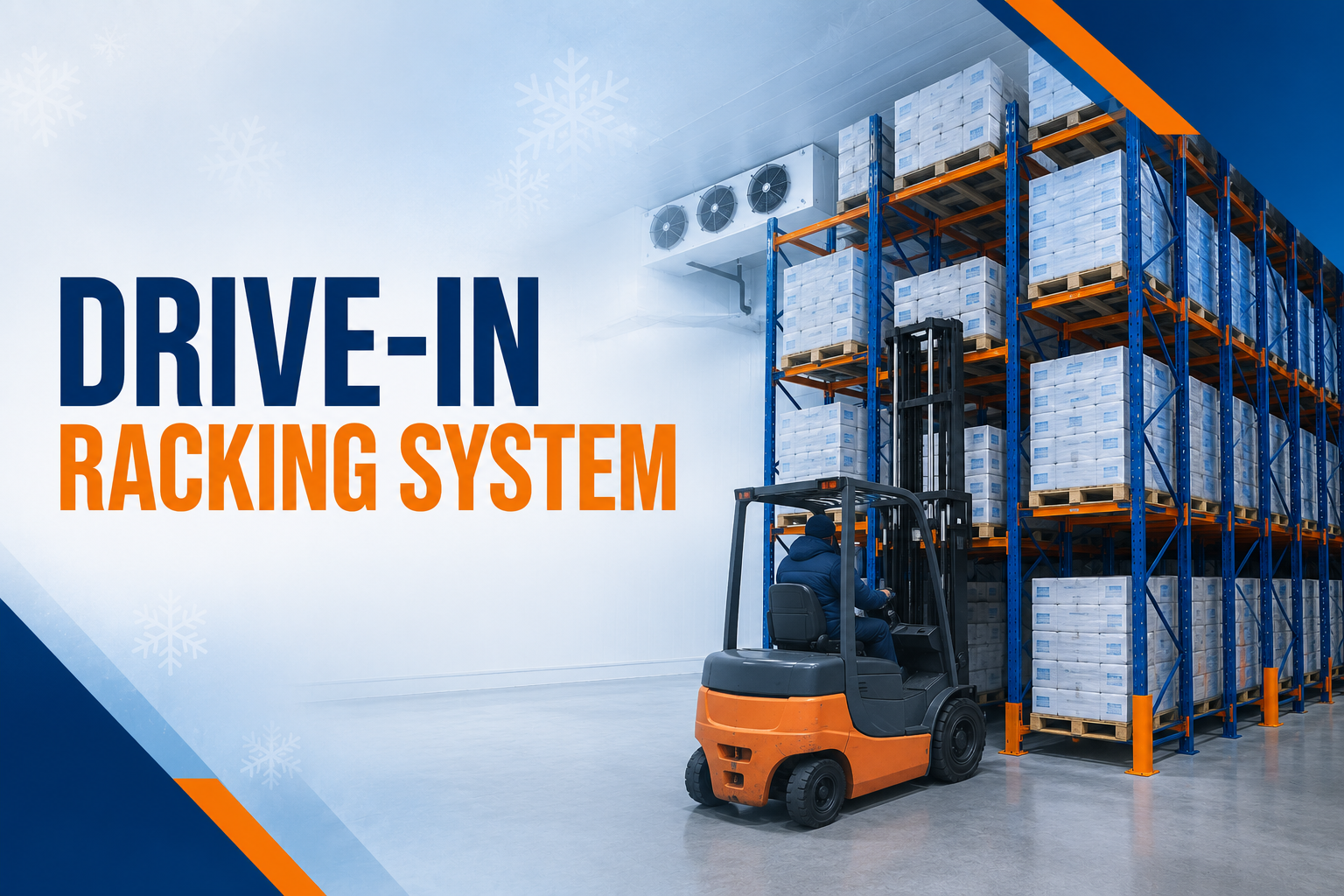
A Drive In Racking System is really a high density storage solution for warehouses, where a forklift can simply drive straight into the racking structure and, you know, put away or pick out pallets from inside it.
Unlike conventional pallet rack setups that usually require several aisles, a Drive In Racking System needs fewer aisles but it uses deeper storage lanes. As a result it means more goods can be stored in the same overall area, because the system kind of stacks space in a more clever way than the standard arrangement.
How does a Drive In Racking System work ?
A Drive In Racking System typically has these parts:
- Vertical frames
- Horizontal rails
- Deep storage lanes
- Forklift access ways
Forklifts enter the racking system and position pallets on the supporting rails, then the pallets sit further back in the lanes. This approach basically uses the available space more efficiently, even if the overall warehouse footprint stays the same.
So yes, it makes a Drive In Racking System a pretty effective and space saving storage method.
The Challenge Faced by the Cold Storage Facility
So there was this cold storage place, big warehouse type of deal, and they were running into a bunch of operational headaches, like day to day stuff that slowly adds up. Not exactly one single thing, more like a few problems that kinda feed each other.
First issue, High Energy Costs.
You know, cold storage is not gentle on electricity. It’s basically constantly working to keep the right refrigerated temperature. In other words, every cubic meter of space needs power, and if you lose control of the setup, the bills climb pretty fast.
- They were paying high electricity bills mainly because:
- There was a lot of cooling happening across the large storage areas.
- Even the empty zones were still being kept cold, which felt kinda wasteful.
- And the overall storage capacity wasn’t really optimized, so the layout wasn’t doing favors for them.
Second issue, Limited Storage Capacity.
Even though the facility looked large, the classic pallet racking system left quite a lot of space sitting there unused, or at least not used in the best possible way.
A bunch of things made it worse:
They had multiple aisles, which ended up cutting down how many pallets could actually fit.
And as demand kept increasing, they were basically cornered into a decision that went like this:
- Expand the warehouse, or
- Build more cold rooms, or
- Find a storage solution that actually makes sense.
But expansion, for either option, meant serious money, and they didn’t want to burn capital just to get more room.
Third issue, Rising Operating Costs.
Meanwhile, operating costs were also climbing, because they were
- spending on additional warehouse space,
- energy consumption,
- equipment movement, and
- even labor costs.
So management was looking for something practical, a workable approach to reduce expenses without losing efficiency, or without turning the whole operation into a mess.
What made the business go for the drive-in rack system?
After reviewing different storage systems, the business opted to use a drive-in racking system. This was based on the following three reasons:
-
Maximum Utilization of Space
A drive-in racking system may be able to maximize the storage capacity by about 70 percent relative to other standard racking systems. This is because there will be no aisles left in the system; hence, more pallets would be able to be stored in the same space
-
Ideal for Bulk Storage
The warehouse had bulk storage of the same products such as:
- Condensed foods
- Meat products
- Dairy products
- Packaged goods
A Drive-In Racking System is ideal for warehouses dealing with bulk of the same inventory.
-
Lower Cooling Costs
With an increase in the storage capacity but the same size of the cooled space, there would be a reduced cost of cooling per pallet.
Implementation of the Drive In Racking System
The facility worked with warehouse storage experts to design a custom Drive In Racking System.
The project included:
- Warehouse assessment
- Space planning
- Rack design
- Safety inspections
- Staff training
The installation process was completed without major disruption to daily operations.
The new Drive In Racking System transformed the warehouse layout by replacing traditional racks with deep-lane storage structures.
How the Drive In Racking System Reduced Operating Costs
- Increased Capacity for Storage
The biggest improvement came from increased storage density.
Before installation, the warehouse could store approximately 5,000 pallets.
The Drive In Racking System increased storage capacity to nearly 8,000 pallets. This represented a major improvement without expanding the building.
Lower costs per pallet resulted from having more storage in the same area.
-
Reduced Energy Consumption
Cold storage facilities spend a large portion of their budget on refrigeration.
The Drive In Racking System helped reduce energy costs because:
- More products occupied the same refrigerated space.
- Cooling efficiency improved.
- No additional cold rooms were required.
- The company effectively stored more inventory while using nearly the same amount of energy.
As a result, energy costs per pallet decreased significantly.
Reduction of Cost through Drive In Racking System
More Pallets Storing Capability It was the most significant achievement because of improved storage capability.
Without installation of drive-in racks, the warehouse was capable of storing around 5,000 pallets.
But with the help of drive-in racks, pallet storing capacity reached nearly 8,000 pallets. This was an improved storage system without increasing any cost.
Lower Labor Costs
The optimized layout reduced unnecessary forklift movement.
Workers spent less time transporting pallets between locations.
This improved productivity and reduced labor costs.
Benefits included:
- Faster pallet placement
- Faster retrieval
- Reduced travel distance
- Better workflow efficiency
The Drive In Racking System helped the warehouse accomplish more work with the same workforce.
Key benefits of a drive in racking system for cold storage facilities
Drive in racking, it really helps with space. It’s honestly one of the best options for maximizing warehouse area. When you use it you can cut down on aisle requirements, and in the end you get a lot more storage capacity than with more “normal” layouts. This matters even more in cold storage, because every square meter costs a lot to keep cold, so wasting room feels painful.
On the cost side, refrigeration is usually the big bill. With a drive in racking system, businesses can park more products inside the same refrigerated space. That means less overall energy gets used, and the system costs less to run… not just a little, but noticeably.
High density storage is another big point. This type of racking is made for warehouses that handle a lot of similar goods. So it gives you better storage density, and it makes better use of the full warehouse volume. It’s kind of like using the space more “deeply” rather than spreading things out everywhere.
Then there are cost savings that build on each other. Think about:
- Reduced energy use
- Improved space utilization
- Delayed expansion
All of that plus lower labor expenses, can create meaningful long-term savings. A lot of businesses end up getting their investment back mainly through those operational reductions.
Finally, the return on investment can be strong. If the drive in racking system is designed properly, businesses can raise storage capacity without buying extra land or building new facilities. So overall it turns into a very cost-effective solution, even if you start by upgrading only the storage layout.
Best Practices When Using a Drive In Racking System
If you want the best results, businesses should really stick to a few recommendations and not just hope it works out:
-
Do Regular Safety Inspections
You should inspect the rails, the frames , and the main structural parts on a regular basis.
That routine maintenance basically keeps everything working well, and supports long term performance.
-
Train Forklift Operators
Since forklifts actually need to enter the storage lanes, operator training becomes pretty essential.
With the right instruction, the chances of rack damage go down noticeably.
-
Organize Inventory the Right Way
Try to place similar products in the same lane, it sounds simple but it helps.
This setup increases speed, plus it strengthens inventory control, not just storage.
-
Work With Experienced Racking Suppliers
When you partner with a supplier that has real know-how, you end up with a professionally designed Drive In Racking System that supports safety, durability, and maximum storage performance, overall.
Conclusion
For cold storage facilities, maximizing storage space i s one of the most effective ways to cut operating costs. The case discussed here shows how a Drive In Racking System helped a cold storage warehouse boost storage capacity, enhance efficiency, reduce energy use, and avoid pricey expansion work
A Drive In Racking System is not just a storage solution, it is basically a strategic investment that helps businesses optimize warehouse space, push operational performance, and reduce long term costs.
Since cold storage demand keeps growing , companies that want better profitability should strongly consider putting a Drive In Racking System in place. With its high density design, strong space utilization, and well proven cost saving advantages, a Drive In Racking System is still one of the more effective warehouse storage options around today.