With fixed shelving, aisles stay in place all the time. A mobile shelving system changes that. You can keep several shelf runs close together. Then you open an aisle only when you need to reach a specific section. This lets a business hold more stock without pushing walls outward.
When a site runs out of room, faces high costs for new floor space, or sees more items to track, mobile shelving can be a steady option. It helps make the most of the area you already have while keeping storage in a neat, orderly layout.
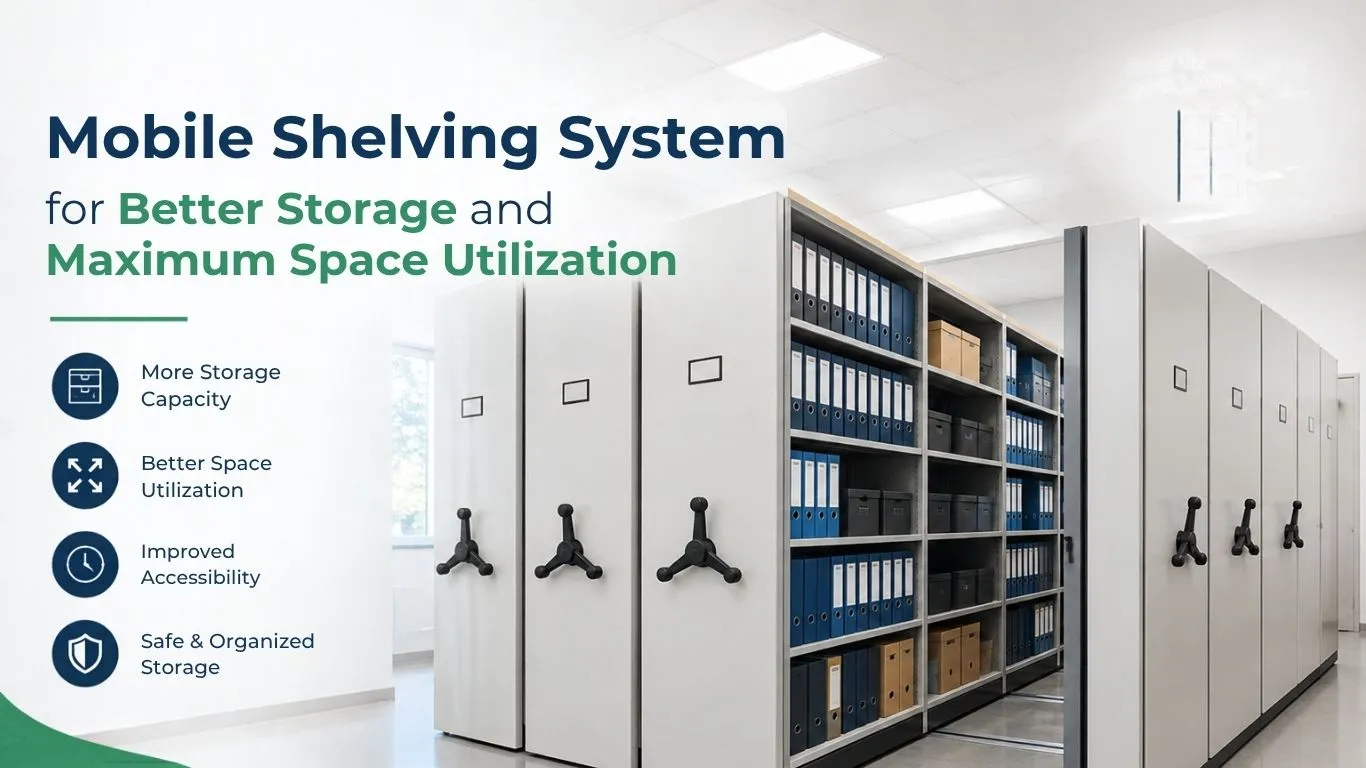
A mobile shelving systems is a storage setup made to move. The shelves are mounted to wheels or carriages. The whole unit rolls along guide tracks placed on the floor. With this design, you do not leave one wide walking lane open all day. Instead, you open space only when a worker needs to reach the shelves.
What Is a Mobile Shelving System?
This can help organizations use space more tightly. In many locations, it also makes better use of the available floor area.
A typical mobile shelving system has several parts, such as these:
- Shelf frames or the shelving body
- Mobile bases or carriages
- Guide rails or floor tracks
- A way to move the units, either by hand or with power
- Safety hardware and locking parts
- End panels and other protective components
- Optional features for access or day to day use
The exact layout can vary. It depends on what the shelves hold, the room size on site, and how often people need to reach the stored items.
How does a mobile shelving system work?
A mobile shelving system uses tracks and guided rails. The shelves are set in rows that slide side to side. An operator pulls or moves the rows so an open walkway lines up with the spot that is needed.
After the item is retrieved, the walkway is shut. The rows slide back and the shelves sit close together again.
This shifts the usual way warehouses plan space. Instead of keeping multiple permanent aisles, the site can save that area for storing goods.
For instance, with normal fixed shelving, you often need several aisle lanes. With mobile shelving, those lanes can be combined. Access is made only at the time it is needed.
You do not have to expand the footprint to get the gain.
Why consider mobile shelving?
A lot of firms start with mobile shelving because it adds space for items without taking over more floor. In many offices and warehouses, it can be the most practical path.
Below are the usual upsides you can expect from a solid system.
One: more storage per square meter
Mobile units allow you to do with fewer fixed aisles. When you rely less on permanent walkways, you can plan more shelf runs inside the same footprint.
Two: smarter use of the space you already have
With fixed shelving, part of the floor is often tied up as walkways. You might not need those same paths all the time. Mobile shelving uses rows that can move, so more of the room can be used for storage.
Three: easier and clearer picking
This is not only about capacity. It also supports a tidy layout. Items can stay in a set order, like products, files, tools, parts, and other supplies.
Four: more control over who can reach items
Sometimes you need to restrict access to certain zones. That can help with records that should not be seen, high value goods, medicines, tools, or other items that need tighter oversight.
Five: you can hold off on new build work
If you can make extra space in the current site, you might not need to expand right away. That depends on a few things, like the floor layout you have.It also depends on the shelf size you pick and how much weight the units have to support. You need to think about aisle clearances too. Finally, consider how your team works each day.
Where Are Mobile Shelving Systems Used?
Mobile shelving systems are used in several kinds of spaces. They work well when you want more storage in a smaller area. You also get easier, organized access to items. In these setups, you do not need to reach every aisle at the same time.
Common applications include:
- Warehouses
- Industrial stores
- Spare-parts rooms
- Tool rooms
- Archive facilities
- Document storage
- Retail backrooms
- Pharmaceutical storage areas
- Medical supply storage
- Libraries
- Offices
- Maintenance stores
- Manufacturing support areas
- Records management facilities
For example, an industrial facility may use mobile shelving for maintenance parts, tools, electrical components, consumables, and slower-moving inventory while keeping fast-moving products in open-access storage.
What Items Are Suited to Storage on Mobile Shelving?
Mobile shelving is suitable for storing small and medium-sized items, including:
- Files and documents
- Boxes and containers
- Spare parts
- Tools
- Bins and containers
- Medical supplies
- Apparel
- Electrical parts
- Maintenance supplies
- Records
- Small parts
- Retail items
Mobile shelving must be selected according to the size, weight, handling, and access requirements of the stored items. Larger and heavier items require different storage solutions than smaller and lighter ones.
What Should You Consider Before Buying a Mobile Shelving System?
Selecting a mobile shelving system should begin with the application rather than the product.
Several factors should be assessed before installation.
1.Load Capacity
Load requirements are one of the most important design considerations.
The supplier should determine:
- Load per shelf
- Load per bay
- Total carriage load
- Shelf dimensions
- Load distribution
- Expected operating conditions
A shelving system should never be selected solely according to appearance or dimensions. The system must be engineered for the loads it is expected to carry.
2.Floor Condition
Mobile shelving depends on accurate track installation and proper alignment.
The existing floor should therefore be assessed for:
- Levelness
- Structural suitability
- Surface condition
- Load-bearing capacity
- Track installation requirements
An unsuitable or poorly prepared floor can affect movement, alignment, durability, and long-term system performance.
3.Frequency of Access
How often employees need to retrieve products is another critical consideration.
If access is occasional, a highly dense layout may work effectively.
If several employees need simultaneous access throughout the day, the layout should provide sufficient operational flexibility to avoid unnecessary congestion.
4.Item Dimensions
The size and shape of stored materials determine shelf dimensions, bay configuration, clearances, and overall system capacity.
A properly planned mobile shelving system should accommodate current requirements while allowing reasonable flexibility for future inventory changes.
5.Available Floor Area
The objective is not simply to install as many shelving rows as possible.
The layout must balance:
- Storage density
- Working aisle requirements
- Operator movement
- Emergency access
- Safety requirements
- Inventory handling
- Future expansion
A professional site assessment can help determine the appropriate configuration.
Manual and Powered Mobile Shelving Systems
Mobile shelving systems are typically available in manual and powered forms.
Manual Mobile Shelving
Manual mobile shelving is usually operated by turning a handle or wheel.
It can be used for
- medium loads,
- small installations,
- infrequent access,
- offices,
- archives,
- spare-parts storage,
- controlled storage.
A manually driven mobile shelving system can create a good cost-performance ratio and is often easier to install since it does not require the additional controls and electrical wiring of a powered system.
Mobile Shelving with Power
Mobile shelving with power uses an electric motor to move the shelves. Powered mobile shelving can be the right choice for
- heavy loads,
- installations with large storage areas,
- frequent access,
- when reducing manual work is a priority.
In addition, powered systems can offer more flexibility and functionality, such as control panels, safety sensors, emergency stop, access control, and other options. The choice between a manual and a powered system should be based on the expected loads, the size of the installation, the access frequency, budget considerations, and specific operations and preferences.
Can mobile shelving increase warehouse storage?
Yes, it can. A mobile shelving system can increase the amount of warehouse storage by minimizing the floor-space requirement for permanent aisles.
However, this benefit cannot always be defined in a neat percentage, because it depends on the current layout and operating requirements.
The factors include:
- The width of existing aisles
- The number of rows of shelves
- The depth of shelves
- The height of bays
- The level of access required
- Fire and safety regulations
- The size and weight of products
- Floor loads
- Operator traffic
That’s why a site-specific calculation of the layout is a better guide than a general statement about storage-density.
Is Mobile Shelving Suitable for Every Warehouse?
Not necessarily. A mobile shelving system is not a good choice for every storage facility. If your warehouse or storage room makes any of the following demands, you may be better off selecting a different type of storage furniture:
- your storage space requires multiple aisle access at the same time
- inventory moves very quickly in and out
- your staff needs forklift access at all times
- storing products on large pallets dominates your storage needs
- the picking process is high volume and needs to take place in many different locations
These are just examples. There may be other reasons why a different type of storage solution, such as pallet racking, narrow-aisle racking, carton flow storage or picking systems would be a better choice. For instance, manufacturers and distributors that deal in high volume, palletized inventory would find their workflow better supported by pallet racking, while a fast-moving, low-volume business might need more open storage space or some form of picking system. The point is, the technology used in a storage facility must be selected to suit the needs of its inventory.
How Mobile Shelving Fits Into a Complete Storage Strategy
The most efficient warehouse or industrial storage facility rarely depends on a single storage system.
Different inventory profiles require different solutions.
For example:
- Fast-moving products:
Open-access shelving or gravity flow racking can support frequent picking. - Palletized inventory:
Pallet racking can provide structured storage for larger and heavier loads. - Small parts and organized inventory:
A mobile shelving system can provide high-density storage while maintaining controlled access. - Restricted floor space:
High-density storage solutions can help maximize the existing footprint. - Narrow warehouse layouts:
Narrow aisle racking may be considered where forklift access and available aisle width are key design factors.
The goal is not to install the most sophisticated storage system. The goal is to create a storage layout that matches the inventory and workflow.
How Mobile Shelving Fits Into a Complete Storage Strategy
It is rare for a warehouse or industrial storage facility to be able to maximize square footage by relying on only one type of storage system.
Depending on the type of inventory, it may be more storage-efficient to utilize different systems for different inventory types
- Fast moving inventory storage such as open shelving or gravity flow,
- palletized inventory storage such as pallet racking,
- small parts or organized inventory storage such as mobile shelving,
- storage with limited square footage such as high density storage,
- warehouse storage with limited aisle width such as narrow aisle racking,
or a combination of these methods may be used. The point is, it is better to have the types of storage that fit the needs of the inventory, rather than the inventory having to fit the system.
Final Thoughts
Finally, a mobile shelving system is an excellent way to optimize warehouse space by enabling higher density storage, boosting the use of floor space, and organizing the storage without taking up much area in a building.
The system is beneficial if its design is guided by the actual use that the company will put it to instead of just buying a unit based on its ability to store goods.
Before buying such a system, several factors must be considered, including the type of inventory, loads, accessibility, floor structure, space, safety, and future requirements.
With proper consideration of the attributes mentioned above, mobile shelving is perfect for intense storage needs.