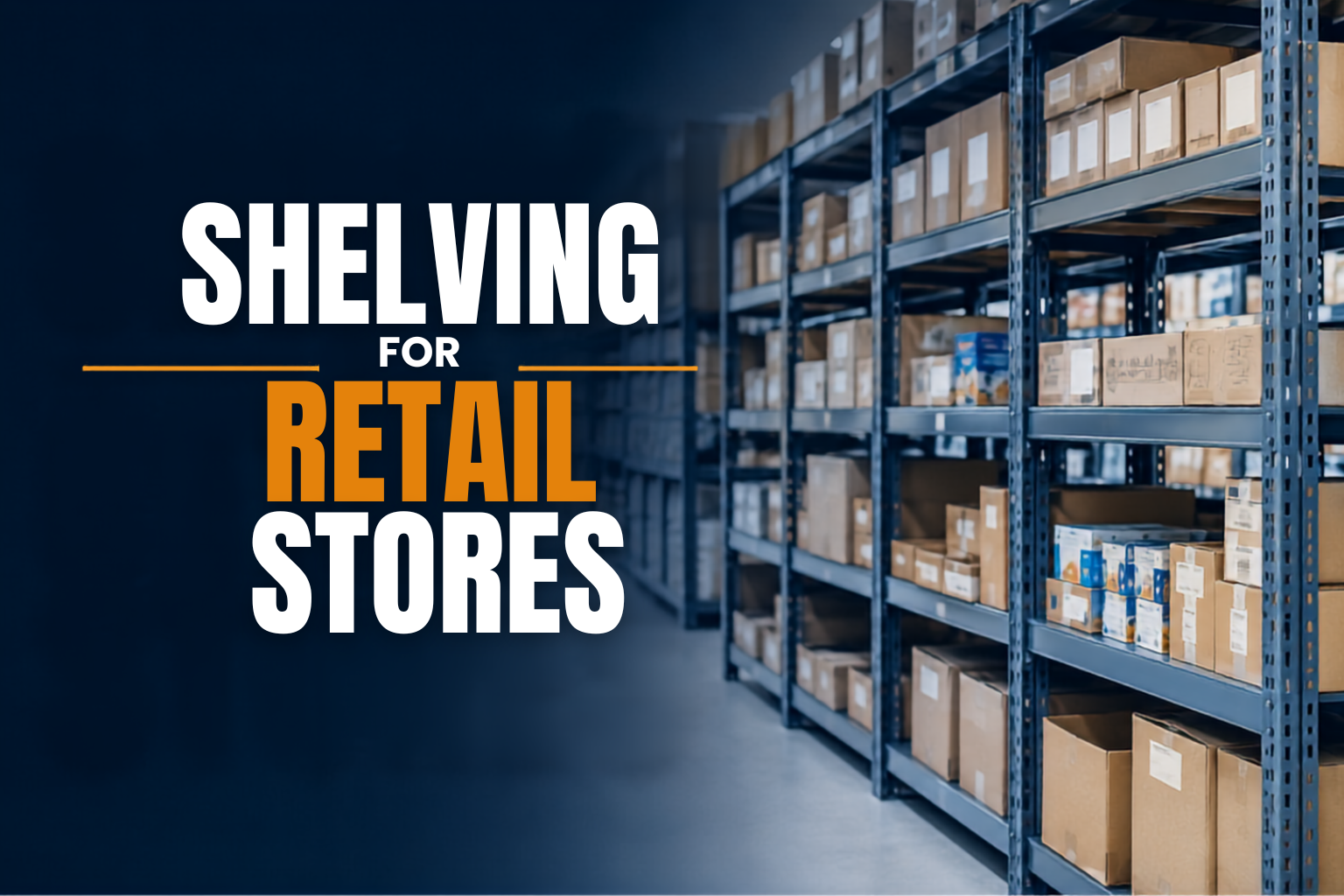
Effective stockrooms enable retail stores to maintain up-to-date shelves, ordered inventory, and to easily service customers without making them wait. Shelving for Retail Stores not only provide additional storage, they help in finding goods in less time, promote a stock visibility of the items, ensure safe goods handling and allow the most usage of the small back room space available.
While a warehouse operates on a large floor space and allows use of large forklift trucks etc, stock rooms in retail business have small square floor space, are in the presence of numerous SKUs, allow picking by hand or a manual truck and have constantly changing inventory. All of which imply shelving best suited for retail stores must manage the elements of strength, accessibility, flexible usage, space efficacy, among others. No matter the sector your retail store is in (Fashion store, Supermarket,Pharmacy, Electronics store, hardware store or a general retail store), implementing the most appropriate shelves for the retail store is guaranteed to directly affect the businesses.
What makes the best shelving for retail stores?
It all comes down to what your product looks like and how frequently you’re restocking it. For instance, a fashion store stocking boxes full of clothing won’t have the exact same needs as a supermarket with lots of packaged products and back-up stock for promotions. Even within these two scenarios there are vast differences—pharmacies, electronics retailers, home-improvement stores, etc.—all demand different considerations when designing their shelves.
Most retailers can benefit from a shelving solution that addresses these four areas effectively:
- Load capacity (no deflection)
- Visibility
- Manual picking ease
- Efficient utilization of available vertical space
The importance of material strength shouldn’t be overlooked either. Although light duty shelving can seem more economical when you consider initial outlay, you’ll likely have to replace your shelves frequently due to damage caused by heavy items such as boxes. On the contrary, steel shelving will give you consistent results over time.
With regard to adjustability, this is especially relevant within the retail sector. Inventory levels change depending on seasons and promotion, not to mention different sizes of packages and category expansions. Therefore, adjustable shelving solutions provide maximum flexibility without having to worry about wasting valuable cubic space.
If fixed shelving units don’t suit your needs then consider adjustable shelves instead – they offer tremendous adaptability without compromising safety standards for employees tasked with stacking goods safely on top!
Common shelving types and where they work best
A boltless steel shelving system is an ideal solution for many retailers that are looking to set up their stockroom using basic shelving units. This shelving configuration allows you to quickly assemble your unit, easily reconfigure them to adapt to changes in your SKUs (stock keeping units) profile and still maintain adequate strength to hold heavy-weighted cartons.
This style of shelving system would typically suit retail outlets whose inventory consists mostly of medium load weight stock and/or require high levels of turnover and product movement within their stockroom. These shelves work well to store retail inventories consisting of apparel, general merchandise, electronics accessories, packaged consumer goods and reserves stocks stored in either cartons or totes.
If your stockroom contains bulkier cartons, larger-sized reserve stock packs or greater quantities of products per shelf bay then I’d recommend looking into purchasing a longspan shelving system rather than standard size ones. A longspan shelving system includes greater beam span widths and sturdier structural supports than regular sized shelving units allowing them to take much heftier weights without suffering structural failures or buckling down under load.
These types of systems tend to cater to homegoods and auto parts retailers as well as large-scale hardware stores or larger format retailing operations where there’s no room for smaller shelving systems due to increased product sizes.
With floor areas becoming increasingly difficult to come by, some retailers have started deploying mobile shelving systems. By setting up these types of units on mobile bases, business owners can maximize their available warehouse storage area while still maintaining easy access to key categories of inventory. However, having said that, this does compromise overall pick speeds – particularly those times during peak hours when several members of staff might require access to various locations throughout the building simultaneously. Mobile shelving therefore only becomes relevant where stocking densities are high but picking volumes are lower.
Of course there’s more than that — you’ll probably need bins, dividers, and some sort of modular shelf accessory system, too. Otherwise your shelves won’t really be solving all those organization issues I mentioned earlier.
When small SKUs, loose stuff, beauty products, accessories, and spares aren’t segregated from each other by clear dividers and containers, then picking them becomes a nightmare. And integrated bins and dividers can help boost pick accuracy while reducing time spent searching for things on shelves.
Load capacity is where many stockrooms get it wrong
Load capacity – Where many stockrooms go off track when choosing shelving units. Another one of my pet peeves about retail spaces is how often I see shelves installed without factoring their load capacity into consideration. It’s pretty common among retail owners to choose a shelving unit purely based on its dimensions but neglecting the weight each shelf will hold, as well as the weight held in each bay of the system. When you’re shopping for shelving units, don’t just think about how big they are. Think about how much stuff you’ll have on them! If your stockroom needs heavy shelving then you need thick steel, sturdy uprights and reinforced shelves.
Try calculating the average and peak load per shelf, sorted by category. How much do beverage cases weigh compared with canned foods? How much more does hardware weigh compared with paper products? What’s the difference between storing boxed appliances versus other items? Knowing what you store is critical in defining your shelving capacity requirements.
This is another safety consideration as overloaded/ill-anchored shelves pose a serious threat to your warehouse.
In particular, this means increased risks for shelf/collapse, product damage, and staff injuries. As such, this will be a big problem when working in a bustling backroom environment.
Layout is as important as the shelving itself
But even the best shelving system suitable for your retail stockrooms will perform badly if you get its layout wrong. For example, think about implementing a high capacity system without taking care how this may impact the way goods move around your premises.
You may want to plan your stockroom around the flows of inventory – putting fast-moving lines within easy reach (ideally knee and shoulder height) and slow-moving or seasonal reserve stock on higher (perhaps less accessible) levels. Or perhaps deliveries are received in cartons, but they are then re-stocked from inner packs or individually. Your stockroom needs to be able to facilitate such scenarios, without pickers having to crack open cases as they traverse an aisle.
Think about the width of each aisle for the way you will need to handle your stock. It may make sense for your staff to be able to move freely using their own muscle-power without being forced to squeeze past narrow passageways if you are handling high volumes manually. But if parts of your stockroom require movement using other equipment, such as stock carts, ladders, or pallet jacks, you need to provide sufficient room to turn things round smoothly. This may mean sacrificing some of your precious real estate in your stockroom – but otherwise you may end up increasing your labor overheads needlessly.
Returns, promotional stock, damaged goods, high value items and daily replenishment shouldn’t be fighting for space on the same shelves. With proper zoning, you will find that things are less likely to get misplaced, and your staff will spend far less time doing replenishment or stock checks.
Durability, Hygiene, and Maintenance should be built-in
Backroom storage is a challenging environment for any shelving system. Shelving is subjected to the daily wear and tear of cart traffic, dust, and the handling of a wide range of products by numerous workers during multiple shifts. The combination of a powder coated steel finish, plus easy to clean surfaces, will help any shelving system resist the wear and tear of daily use and remain sanitary for grocery, pharmacy, and other healthcare environments.
Shelving systems should be designed to make maintenance simple while also being able to withstand the test of time. The ability to perform routine, but thorough visual inspections for damage, defects, or improper loading is a crucial component of any shelving system’s long-term value.
As your business grows and changes, shelving systems should provide the flexibility to respond to increased categories, seasonal changes, and shifts in corporate strategies such as merchandising and regional specialties. The shelving systems of the future will most likely utilize add-on shelving, bays, and accessories that offer the adaptability of a system that can change without having to start over.
How to pick the best setup for a shop
Start with what you keep in the store. Do not begin with a catalog. List the sizes of the items, the weight bands, and how many different SKUs you have. Also note how often things are picked and how fast you need restocking. Then look at the space. Measure the room height, the wall length, and where deliveries and doors are. Check any rules for fire access and any limits from backroom tools.
After that, the right answer usually becomes clear. For most retail spaces, boltless steel shelving is often the easiest to adjust. It tends to work well when you may change assortments later. If you need more density, more reach, or more capacity in each spot, longspan shelving can fit better. If you have less floor space and picking is not done very often, mobile shelving may be a smart choice too.
One thing to avoid is treating shelving like a ready item you can force into place. The stockroom is not simple. The wrong storage plan can hurt output, lead to picking errors, raise product damage, waste floor area, and reduce safety. That is why larger teams often go for one full system instead of separate standalone units.
If you are looking at new installs or planning a storage area update, it helps to work with a team that has done this work before. A good partner can help you avoid costly mistakes in how the space is laid out.
AME Racking is one example. They do more than drop off shelving. They also help with load planning, make better use of the available room, and build the system around how the site really runs.
The best stockrooms are not the ones with the highest number of shelves. The better option is a layout where each spot has a job. Loads must be handled the right way, and staff should be able to restock the sales floor fast.
When the shelving is picked with that goal, the back room does not slow things down. It starts working like a real part of the retail setup.